
Guide - Published on March 11, 2026
How to calculate a selling price for a target margin
Setting a product price looks simple. Many businesses take supplier cost and add a percentage that sounds reasonable. The problem is that this method often leaves the business with a much lower margin than it believes.
This mistake is especially common in small ecommerce businesses and retail stores. It happens every day: the business sells, invoices, moves inventory, but the real profit at month end does not match expectations.
The reason is usually the same: price was calculated with markup on cost instead of calculating against a target margin on the final selling price. That small difference changes profitability completely.

The silent pricing problem in small businesses
Many businesses work hard to sell more: they spend time on marketing, manage suppliers, update inventory and prepare orders. But very few spend time checking whether each product price is actually producing the margin the business needs.
The result is a silent problem. Products sell. Units move. Cash comes in. But real margin ends up too low. In other words: the business works harder, but earns less than it should.
Silent loss monitor for misread markup
Move these values and see how much margin and monthly money is lost when the business thinks it is applying margin while it is actually applying markup.
The difference between pricing with margin and pricing with markup
Markup and margin are often confused, but they are not the same. Markup is calculated on cost. Margin is calculated on the selling price. Even though the formulas look similar, the outcome is different.
Markup (%) = (Price - Cost) / Cost x 100
Margin (%) = (Price - Cost) / Price x 100
| Concept | Value |
|---|---|
| Cost | 10 EUR |
| Price | 15 EUR |
| Markup | 50% |
| Margin | 33.3% |
A business that thinks it is working with a 50% margin is actually operating at just over 33%. When this error is repeated across the whole catalog, real profitability ends up far below expectations.
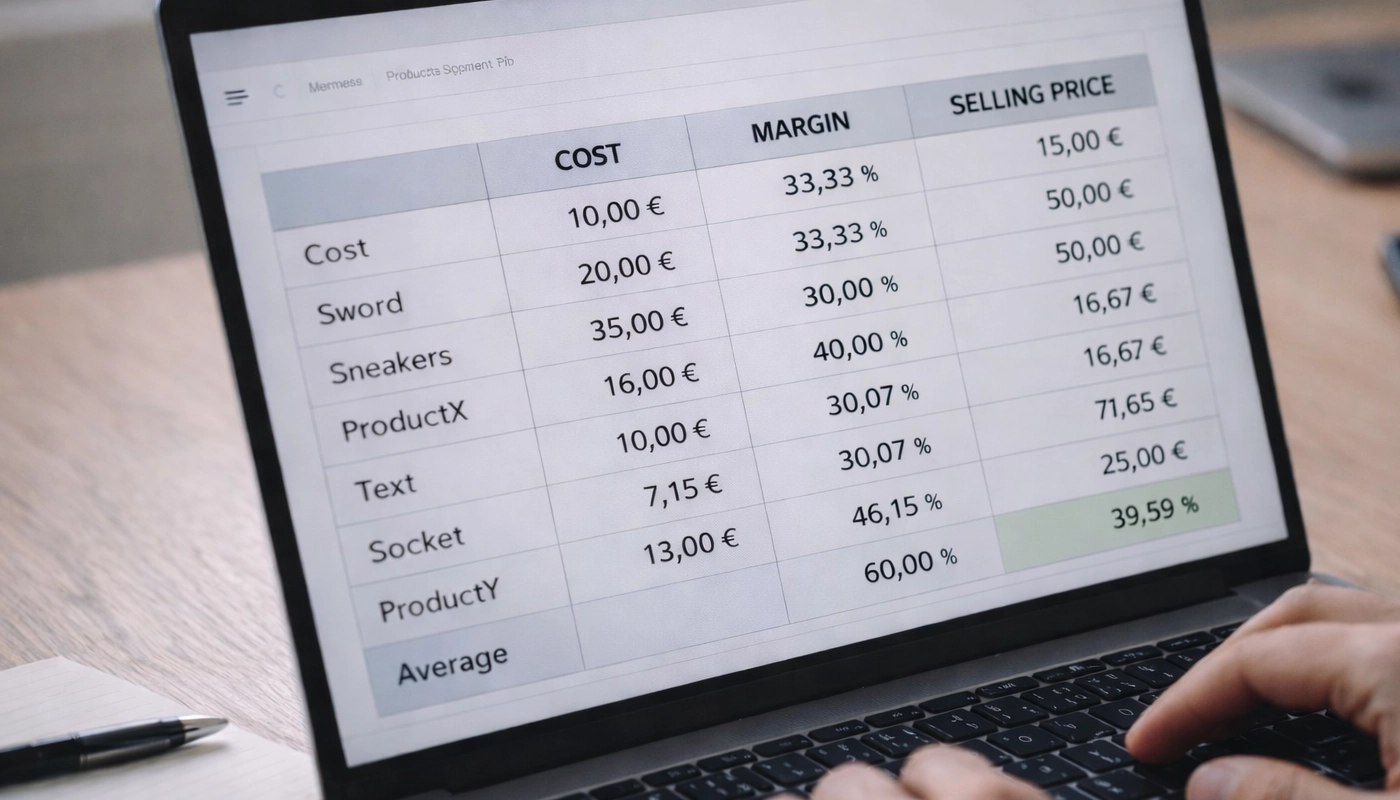
The correct formula to calculate price from a target margin
If you want more accurate pricing, the process should start in reverse: first define the margin your business needs, then calculate the selling price.
Selling price = Cost / (1 - Target margin)
Practical example: product cost 10 EUR, target margin 40%. 10 / (1 - 0.40) = 16.67 EUR. At that price, final margin is truly 40%.
The mistake that makes many businesses earn less than they think
One of the most frequent errors happens when the business believes it is applying a margin but is actually applying markup. Example: cost 10 EUR, markup 40%. The calculated price is 14 EUR, but real margin is only 28.6%.
In a small catalog this can look minor. In a larger catalog it can mean thousands of euros per year.
What margin does a small ecommerce business really need?
Not every sector works with the same margin. Some products face more competition or move faster than others. These are common directional ranges.
| Business type | Typical margin |
|---|---|
| Electronics | 15% - 30% |
| Home | 30% - 50% |
| Fashion | 40% - 70% |
| Accessories | 50% - 80% |
| Private label | 60% - 85% |
Many small ecommerce businesses try to keep margins around 40% or 50% so they can absorb promotions, returns, fees and cost variation.
Margin erosion panel for discounts and fees
This is not a theoretical price widget. It shows how much real margin disappears when you activate promotions and sell through channels with fees.
How to decide margin by product category
Not every product in the catalog should carry the same margin. A common strategy is to split products into three groups.
| Product type | Strategy |
|---|---|
| Traffic products | Low margin |
| Main products | Medium margin |
| Complementary products | High margin |
This keeps key products competitive while improving total catalog profitability.
What happens when costs change
Another common issue is fixing price once and never revisiting it. Costs change constantly: supplier increases, transport changes, exchange rate variation, payment fees and logistics changes.
If price is not updated when these factors move, margin keeps shrinking little by little, and many businesses notice it too late.
Cost increase deterioration radar
This block shows how fast current margin degrades when cost goes up and the selling price stays frozen.
Pricing best practices for ecommerce
Before publishing or updating prices in a catalog, it helps to follow a few basic practices.
- Verify real unit cost.
- Define a minimum margin by category.
- Calculate price using a target margin.
- Simulate discounts and fees.
- Review profitability by product periodically.

How Margynn helps you set better prices
Many businesses still calculate costs and prices in spreadsheets or even manually. The problem is that once the catalog grows, keeping everything updated becomes harder and harder.
Margynn was built to solve that exact problem. The platform can extract products directly from invoices or proformas, calculate real unit cost by SKU, calculate real margin per product, simulate prices from target margins and generate a catalog ready for ecommerce.
If you have not read our other guides yet, you can also review how to calculate real landed cost per product and margin vs markup: how to set price without losing money.
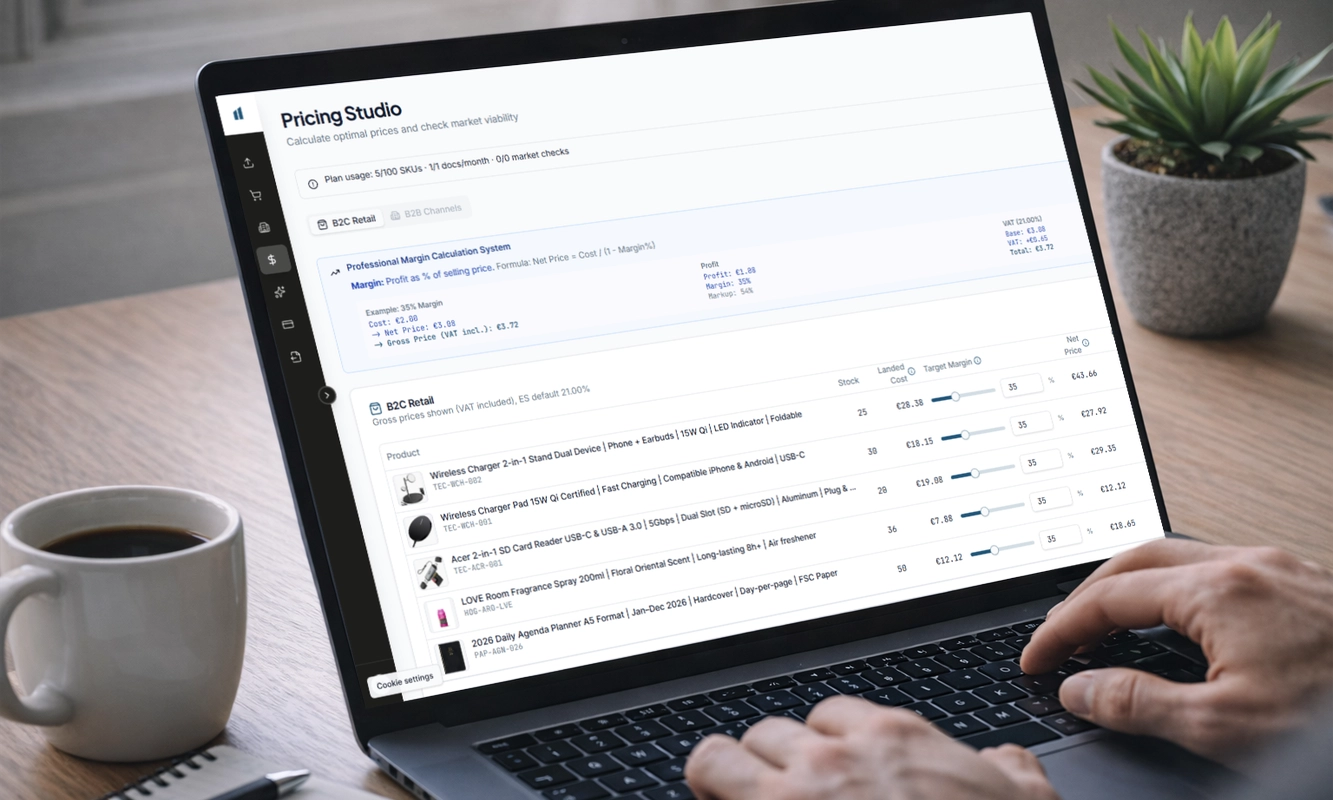
The right price means a sustainable business
Product price should not be driven by intuition or by copying competitors. It should be calculated from real cost and the margin the business needs to grow. When those two inputs are clear, every product contributes directly to profitability.
Frequently asked questions
What is markup?
Markup is the percentage added to product cost to calculate selling price. It is simple, but it does not reflect real profitability on the final price.
How do I calculate selling price for a target margin?
The formula is Price = Cost / (1 - Target margin). If cost is 10 EUR and target margin is 40%, price would be 16.67 EUR.
What is the difference between margin and markup?
Markup is calculated on cost. Margin is calculated on selling price. That is why both values are not equivalent.
What margin should an ecommerce business have?
It depends on the sector, but many ecommerce businesses operate between 30% and 60% to absorb promotions, fees and cost variation.
Do discounts affect margin?
Yes. Every discount reduces revenue per product and therefore reduces final margin.
Do marketplace commissions change real margin?
Yes. Marketplace and payment commissions must be included when calculating real margin.
Is it better to use margin or markup to set prices?
Margin is more useful because it reflects real profitability on the final price.
How often should I review my prices?
Ideally whenever costs change, or when you introduce promotions, new channels or new fees.